






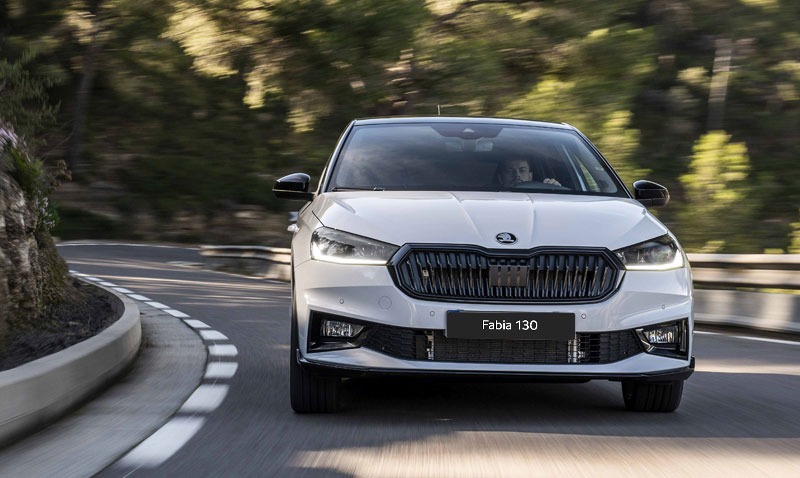
The secrets behind the Škoda Fabia 130
Steering without compromise
“The fourth-generation Škoda Fabia is an ideal foundation for a sporty car. It features short overhangs and compact dimensions, which result in a relatively low moment of inertia. At the same time, the MQB platform offers a wide track, contributing to overall stability. From a conceptual standpoint, it therefore has all the prerequisites to be sporty and dynamic. This is also why it serves as a strong basis for the Fabia RS Rally2 competition car,” explains Petr Šulc from Škoda Auto’s Technical Development department.
A key factor defining the driving characteristics of the Fabia 130 is the steering system, which is influenced, among other things, by wheel size. When tuning steering for models offered with multiple wheel sizes, manufacturers typically have to make compromises to ensure acceptable behaviour across different rim diameters. The Fabia 130, however, is exclusively fitted with 18-inch wheels, allowing the chassis and steering to be tuned specifically for this configuration.
You will certainly appreciate the car’s eagerness to bite into corners
Wheel size affects steering precision as well as the vehicle’s behaviour when entering a corner. An important role is also played by the electromechanical power steering system. In the Fabia 130, it retains the same steering ratio as the Monte Carlo base model, but it has been recalibrated specifically for this version. At speeds of up to 30 km/h, its behaviour is almost identical to that of the standard model, meaning that during low-speed manoeuvring, such as in urban traffic, the driver will hardly notice any difference. At medium speeds (between 30 and 80 km/h), however, the steering becomes more engaging and allows for sharper changes of direction.
Increased steering stiffness around the center position enhances stability and enables clean, precise cornering with small steering angles
At speeds above 80 km/h, the steering becomes stiffer to ensure stability. At the same time, its response remains linear and predictable, allowing for subtle corrections, for example during driving on the highway. At higher speeds, the aerodynamic package also comes fully into play, including a front splitter and rear spoiler. These features reduce lift and contribute to improved vehicle stability.
The steering response can further be adjusted by selecting the Normal or Sport driving modes. Even the Normal setting is slightly sportier than in the standard model, while Sport mode fully unlocks the car’s dynamic character.
Let it slide
Another key upgrade is the ESC Sport system, which was previously reserved for Škoda models with all-wheel drive and high-performance RS variants. It allows for greater wheel slip and a later intervention of the stability control system. “The level of intervention is defined by a calibration engineer to ensure it remains safe while still allowing for driving enjoyment. In this area, we draw on more than 20 years of experience,” explains Petr Šulc. This balance between safety and driver engagement is particularly well executed in the Fabia 130. On closed circuits, ESC Sport allows the driver to induce a mild oversteer far more readily than is typical for Škoda road cars. However, there is a clearly defined limit that prevents excessive rear-end rotation.
ESC Sport mode is activated via the infotainment menu
Among the modern driving aids featured in the Fabia 130 is also the XDS system on the driven front axle. By braking the inside wheel in a corner, it simulates the function of a limited-slip differential. This helps the car to rotate into the corner and maintain traction even under throttle. As a result, the Fabia 130 gains in agility and is capable of more dynamic cornering. Once again, careful calibration by highly skilled engineers ensures that, for example, the braking system does not overheat as a consequence of XDS intervention.
The Škoda Fabia 130 unlocks the sporting potential of the standard model and allows drivers to enjoy engaging performance both on public roads and on closed circuits. It stands as a fitting tribute to the Škoda Fabia RS Rally2 competition car, made accessible to a wide audience.